5 Things I Wish I'd Known Before I Let AI Do My Work
Oct 03, 2026Including the one that ran for seven weeks before I noticed!
Most of what you read about AI in business is written by someone standing at the finish line, telling you how straightforward the race was.
So here's the other version. Five things I got properly wrong, what they cost me, and what I'd do instead.
I'm not telling you these to be charmingly self-deprecating. I'm telling you because every single one is the kind of mistake you only avoid if somebody warns you, and nobody warned me.
Lesson 01
I tried to hand over everything at once
The first weekend I properly understood what was possible, I sat down and tried to set up about eight things.
Content. Email. The inbox. Reporting. The week plan. All of it, in one go, on a Sunday, with a glass of wine and far too much enthusiasm!
By Sunday night I had eight half-built things, none of which worked, and a strong feeling that this was all much harder than people said. I didn't open it again for about ten days.
Here's what I didn't understand. Each job needs its own round of teaching, testing and fixing. That's not a flaw, that's just how it goes. Eight at once means eight unfinished loops and nothing to show for your Sunday.
🪄 What I'd do instead
ONE job. Finished. Running for a week before you touch another. And pick the one you're most sick of, not the one that sounds cleverest, because the feeling of waking up to something finished is what carries you into the second one. Nothing else does.
One finished thing beats eight half-built ones, and it isn't close.
RELATED: 6 Jobs I Now Wake Up to Already Done
Lesson 02
I let it write in a voice that wasn't mine, and I published it
Oh, this is the one that still makes me wince!
Early on I asked for a batch of emails, read them quickly, thought "that's quite good actually", and sent them. They were fine. They were competent. They sounded like a reasonably good marketer who had never met me.
And the thing about competent-but-not-you is that it's so hard to spot in the moment. It isn't bad enough to stop you. It's just slightly flatter, slightly more formal, slightly more like everyone else. You only see it later, reading it back, wondering who on earth wrote that.
Nobody unsubscribes because an email was bad. They drift because it stopped sounding like a person they knew.
What I'd missed was that I'd asked it to sound "warm and friendly", which is a description of roughly four million brands. I hadn't given it a single thing I'd actually written.
🪄 What I'd do instead
Three real things you've written, pasted in, beat any adjective you could choose. Then add the specifics. Do you use contractions? Do you start with "Hi there"? Do you use exclamation marks, or do they make you cringe? And write a short list of words you'd NEVER use. That banned list does more work than the entire rest of the brief, because it catches the things you don't notice until they're published.
"Warm and friendly" is not a brief. Three emails you actually sent is a brief.
Lesson 03
I set something running and never went back to check it
Right. This is the confession!
I had a routine that pulled together a little briefing for me each morning. It worked beautifully. And because it worked beautifully, I stopped reading it properly. Just glanced, felt organised, carried on.
It spent SEVEN WEEKS cheerfully telling me about a launch that had finished. Every morning. For seven weeks! The launch had ended, the information it was reading hadn't been updated, and nothing in the system was ever going to notice that but me.
And here's the bit that actually stung. It wasn't broken. Nothing failed. No error, no warning. It did exactly what I'd asked, perfectly, using information that had quietly stopped being true.
⚠️ The failure nobody warns you about
Things that break are easy. You find out immediately and you fix them. The dangerous ones are the things that keep working perfectly on information that's gone stale. They look healthy right up until someone points out you've been telling people the wrong thing since September.
🪄 What I'd do instead
Two things. Keep the facts that change in ONE place that everything reads from. Your prices, your offers, what you're pushing this month. Then updating it once updates everything. And once a month, actually read one output properly rather than glancing at it. Fifteen minutes. Put it in your diary, because you will not remember.
The question isn't "could this break". It's "could this keep working and be wrong".
RELATED: The 5-Step Setup That Clears My Inbox Before I Wake Up
Nothing failed. Nothing warned me.
It just quietly stopped being true.
Lesson 04
I let it get close to customers before I'd earned the right to
Not a disaster, thankfully. But close enough that I changed the rule permanently.
I had replies being drafted, and I got comfortable. Comfortable enough that one morning I skimmed one, thought it looked right, and sent it without reading it properly. It wasn't wrong exactly. It just answered a slightly different question to the one she'd asked, because she'd been a bit indirect and it had taken her literally.
She was lovely about it. But I sat there afterwards thinking, that was a real person, who'd written to me, and I replied without reading.
So now the line doesn't move. Anything a customer will see, I read. Every single time.
🪄 What I'd do instead
Decide the line before you need it, not in the moment. Mine: it drafts, I send. Always. No exceptions, including when I'm busy, and especially when I'm busy! ⛔ And it never gets permission to send on its own, so the rule isn't relying on my willpower at seven in the morning. Make it structural, not a good intention.
Drafting saves you the hour. The send button costs you four seconds. Keep the four seconds.
Lesson 05
I thought choosing the right tool was the hard part
I spent genuine weeks on this. Comparisons, videos, threads, opinions. Feeling wonderfully productive the entire time.
And none of it changed a single Tuesday!
Because the tool was never the thing. The thing was writing down what my business actually is, deciding what "good" looks like, and being brave enough to hand over something that mattered. And all of that is the same work whichever one you pick.
I know exactly why I did it, too. Comparing tools is comfortable. It feels like progress and it costs you nothing. Handing over a real job is uncomfortable, because it might come back wrong, and then you'd have to deal with that.
Research is what we do instead of starting.
🪄 What I'd do instead
Pick whichever one you already have open and give it a real job this week. You'll learn more in one messy afternoon of actually doing it than in a month of reading. And the learning transfers. What you work out about briefing, context and where to draw the line comes with you to whatever you're using in three years.
Learn the method, not the menu. The method survives the next release.
RELATED: 7 Myths About AI for Small Business You Can Stop Believing
The five, in one place
- ONE job at a time. Finished, running, a week in, before you start the next
- Give it three real things you've written. Adjectives aren't a brief
- Keep the facts that change in one place, and read one output properly each month
- Decide the customer line before you need it, and make it structural
- Stop researching. Hand over something real this week
None of these mistakes were expensive in money. They were expensive in months. Months where I thought this was harder than it is, or where something was quietly wrong and I hadn't looked.
If this saves you one of those months, it's done its job!
Work less, earn more, and get to actually live the life you started this whole thing for. 👑
Want the shortcut I didn't have? 🌙
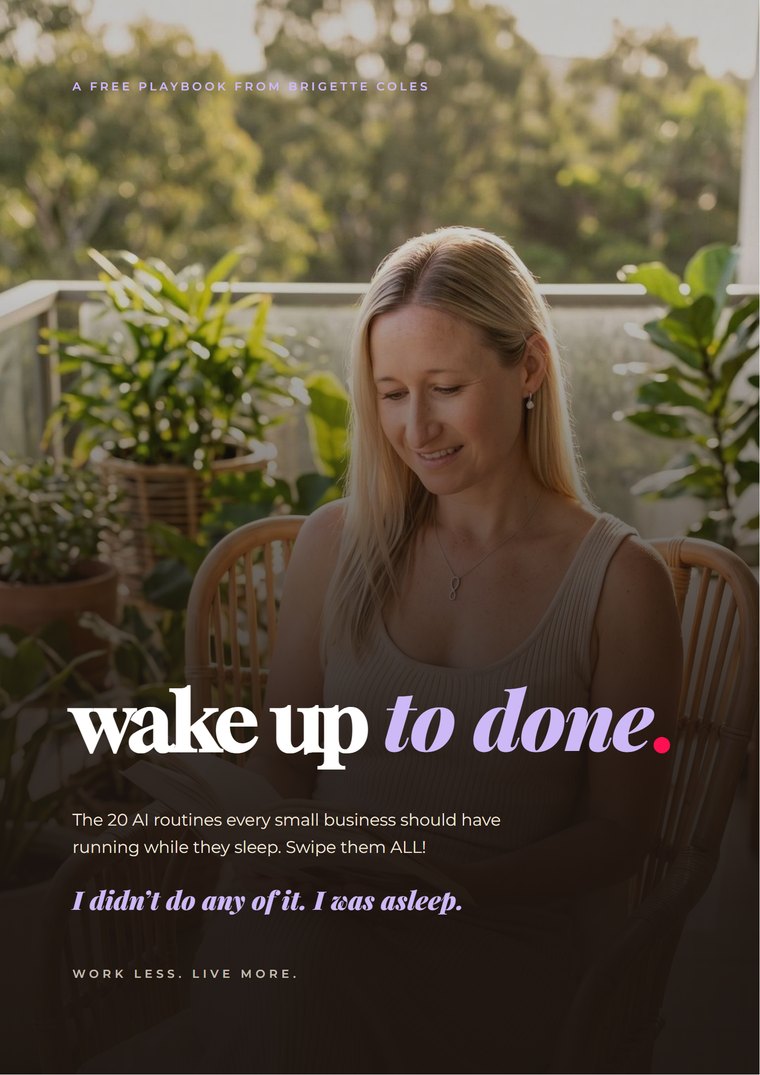
Wake Up to Done
The Night Shift Playbook
The 20 AI routines every small business should have running while they sleep. What each one does overnight, what you wake up to, and how to set up your own version.
Free, and in your inbox in about a minute.