What Is an AI Agent? A Guide for Business Owners Who Are Not Technical
Oct 10, 2026No jargon, no code, and an honest answer to "what do I actually need to have?"
Somewhere in the last year the word "agent" started appearing everywhere, and nobody stopped to explain it. So you're left nodding along in conversations, quietly wondering whether you've missed something you were supposed to already understand.
You haven't! The idea underneath it is genuinely simple, and the people making it sound complicated are usually the ones selling it.
Here's what we'll cover:
- What an AI agent actually is, in normal words
- How it's different from the chatbot you've already used
- The four things every agent needs to be any good
- ⭐ What you need to have, plainly, including the money and the laptop question
- Three real examples, including one that isn't a business like mine
- The smallest possible way to start
The basics
An agent is an assistant you give a job to
That's it. That's the whole thing.
A chatbot waits for you to ask something and answers. An agent is given a job description, the information it needs, and permission to go and do that job. Often while you're nowhere near it.
The difference is the same as the difference between a very good search engine and a very good assistant.
A search engine is brilliant and you still have to be there, asking. An assistant you've briefed properly goes away, does the thing, and comes back with it finished. You stopped asking and started reviewing.
A chatbot answers questions. An agent finishes jobs.
And the reason this matters for a small business specifically: the thing eating your week was never the lack of answers. It was that every single task still had to be started by you, from nothing, while you were sitting there concentrating!
How it works
The four things every agent needs
When one works beautifully and another produces rubbish, it's almost never the AI. It's one of these four missing.
1. A job description. What it's for, and what "good" looks like. Not "help me with marketing" but "every Sunday night, draft the week's posts from my content plan, in my voice, and leave them for me to approve."
2. Context about you. What you sell, who buys it, how you talk, what you'd never say. ⭐ This is the one that separates "sounds like a brochure" from "sounds like me", and it's the one almost everybody skips!
3. Reach. Access to the places your business actually lives. Your calendar, your inbox, your sales, wherever your work really sits. An agent with no reach is guessing, and a confident guess is worse than no answer.
4. A line it doesn't cross. What it can do on its own, and what has to wait for you. Mine draft. I send. Always.
🪄 What actually makes it work
Number two does the heavy lifting and gets the least attention. Written down properly, it's maybe a page. What you sell, who buys it, three things you've written that sound like you, and a short list of words you'd never use. That page is the difference between output you have to rewrite and output you just approve. And you write it ONCE.
The AI isn't the hard part. Briefing it properly is, and that's a thing you already know how to do.
RELATED: Claude vs ChatGPT: Which One Should a Small Business Owner Actually Use?
The honest answer
What you actually need to have
This is the section I wish someone had written for me, because every time I asked, I got a shrug and a link!
Do I need a paid plan? For chatting, no, the free versions are genuinely good. For anything that runs on its own while you sleep, yes. That's across the board, not one provider being difficult. Expect somewhere around twenty US dollars a month, and go and check the current price rather than trusting me.
Does my laptop need to be on? ⭐ No! This is the one that surprises everyone. It all happens on their machines. Mine runs with my laptop shut, which is rather the point.
Do I need a good computer? No. If it can open a browser, it can do this.
Is there code? No. You write instructions in English. If you can write a handover note for someone covering your desk, you can write this.
Is there a horrible setup screen? There's a connections page where you sign in to your email or calendar the same way you sign in to anything, and tick what it's allowed to see. It looks like every other "connect your account" screen you've used!
How long does it take? Honestly, it depends entirely on the job and I'm not going to pretend otherwise. The writing-down-your-business part is the bit that takes real thought, and you only do it once. Everything after that is much faster than the first one makes you think.
⚠️ What it is NOT
It isn't a robot that runs your business. It doesn't make decisions you haven't approved, it doesn't spend money, and it absolutely should not be talking to your customers unsupervised. Anyone promising you a business that runs itself is describing something that doesn't exist. What's real is that a great deal of the preparation stops needing you.
Real examples
Three businesses, three agents
Let me make this concrete, because "an assistant you give a job to" is still a bit abstract.
1. A photographer with retainer clients.
Her job isn't content, it's the admin around shoots. Her agent reads her inbox overnight, pulls out anything from a current client, drafts the straightforward replies in her voice, and writes her a short note each morning saying what's outstanding and who's gone quiet. Nothing sends. She reads, adjusts, presses send over coffee.
⭐ The thing she cared most about was scoping it tightly, because client contracts and private details live in that inbox. So it only looks at one label, and she decided that deliberately rather than finding out later.
2. A bookkeeper with twelve regular clients.
Hers watches for the monthly things that always slip: who hasn't sent their receipts, which deadlines are coming, who's gone quiet. Every Monday morning there's a list, in order, with the chase emails already drafted. The job was never hard. It was just relentless, and it lived entirely in her head.
3. Me, selling digital products.
Mine draft content, watch the numbers, prepare ad concepts and plan my week. Different business, same four ingredients underneath.
🪄 What actually makes it work
Notice what all three have in common, because it's the actual lesson here. None of them handed over the skilled part. The photographer still shoots. The bookkeeper still does the books. I still decide what we sell. What got handed over was the remembering, the sorting and the starting-from-nothing, which is the part that was never the job, and somehow became most of the week.
You're not handing over your craft. You're handing over the admin that grew around it.
RELATED: The 5-Step Setup That Clears My Inbox Before I Wake Up
You don't need another thing on your to-do list.
You need a few things getting done without you.
Getting started
The smallest possible first step
⛔ Please don't start by building an agent! I've watched too many people decide to automate everything on a Sunday, get three hours in, and never open it again.
Start here instead, and it takes about half an hour:
- Open a document and write down your business. What you sell, who buys it, what they usually need from you
- Paste in three things you've written that sounded like you. An email, a caption, a reply to a customer. Real ones
- Write five words or phrases you'd never use. Mine includes "hey lovely" and "unlock your potential"
- Pick ONE job you're sick of that you do at least weekly
Then give that one job away, with that document attached, and see what comes back. Fix the instruction, not the output. Do it twice more. That's an agent.
Everyone wants to start with the clever job. Start with the annoying one. The feeling is what carries you to the clever one.
So, what is an AI agent?
It's an assistant you've briefed properly, that's allowed to reach the places your work lives, and that knows where to stop and wait for you.
Not a robot. Not a replacement. Not something you need to be technical to set up. Just the difference between opening your laptop to a to-do list and opening it to work that's already been prepared.
And if you take nothing else from this: the page where you write down your business is worth more than any tool you could choose! Everything else is built on it, and nobody else can write it for you.
RELATED: 6 Jobs I Now Wake Up to Already Done
Work less, earn more, and get to actually live the life you started this whole thing for. 👑
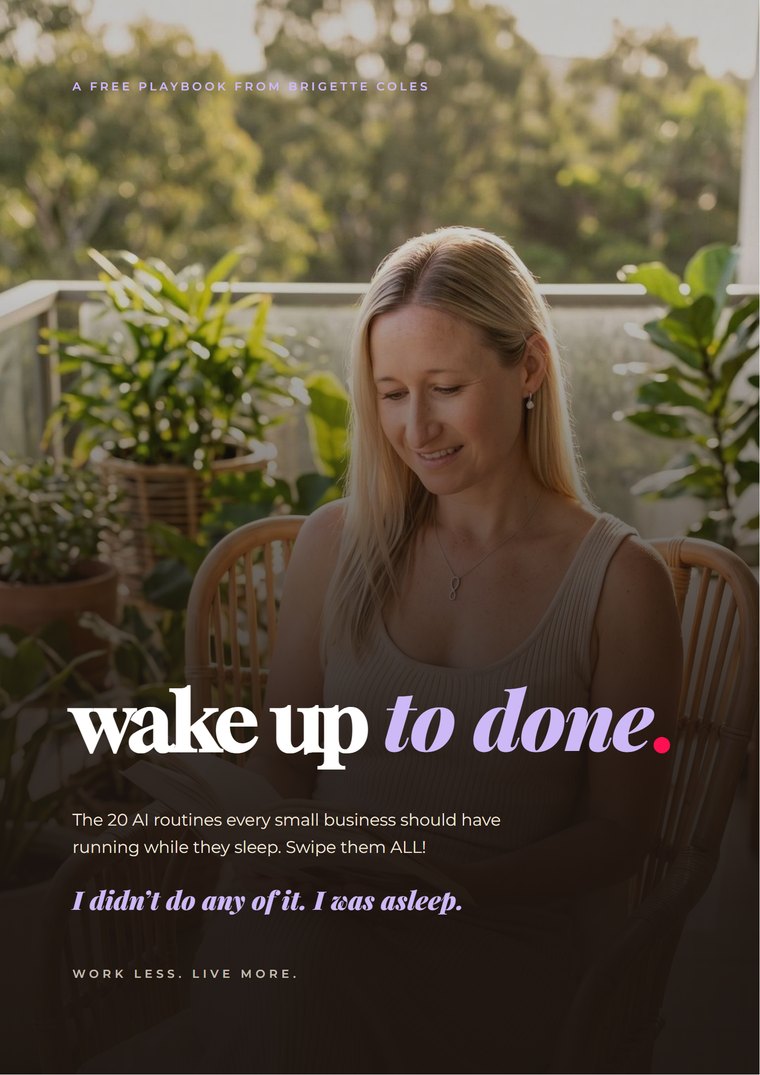
Not sure which job to start with? 🌙
Wake Up to Done
The Night Shift Playbook
The 20 AI routines every small business should have running while they sleep. What each one does overnight, what you wake up to, and how to set up your own version.
Free, and in your inbox in about a minute.